
Cities, regions and the public sector
The infrastructure has long been there. It just isn’t seen.
Hiking trails, lookout towers, fountains, museums, huts: you maintain a network that hardly anyone knows completely. LaceUp turns it into a digital collection map that brings people there — and shows for the first time where they actually go.
Starting point
Where it sticks today
The offering is good. Awareness, distribution and proof are the problem.
A collection pass with postage both ways
Print the card, distribute it, have it filled in, sent back, checked, mail the prize. The effort is considerable, the participation barrier high — and at the end you have a number without context.
Three places are overrun, twenty nobody knows
The well-known spots carry the load, the rest stays empty. Without a steering instrument, footfall can’t be shifted — neither in time nor in space.
Impact is hard to substantiate
Service agreements, subsidies and reports need numbers. Counting stations on trails deliver totals, but no patterns: who comes, from where, how often, in what combination.
A network of objects becomes a map with goals. And every visit becomes a data point that belongs to you.
Formats
Applications for the public sector
No new construction is needed. What’s needed is a selection of points and a story that connects them.
The hiking or cycling trophy
Selected destinations of a region or canton as checkpoints, with tiers and badges. Designed for several years, with focus themes changing annually.
Urban space as a collection map
Fountains, monuments, viewpoints, neighbourhood parks or museums. A format that connects local recreation with cultural education — and needs no travel.
A reporting function along the trail
Anyone out and about can report broken signposts, damage or obstacles directly. Recreational users become a sensor network for maintenance — without additional staff.
Physical activity promotion with a sense of place
Physical activity programmes get concrete nearby goals instead of abstract step targets. That’s lower-threshold and can be tailored to neighbourhoods.
Benefits
What you get out of it
Demonstrable impact
You see which points are visited how often and in what order. That is a robust basis for reports, subsidies and investment decisions.
Distributing footfall deliberately
Weight points, set bonus tiers, define time windows. That steers visitor flows without forbidding anyone anything.
No structural interventions
No boxes, no signs, no power supply, no permits for installations. The checkpoints exist only digitally.
Low-threshold access
The check-in works without an app and without a sports watch, straight in the browser. That way you also reach audiences outside the sports community.
Reference
References
 Trophy
Züri Velo Cup – Winter Quest
From 21 December to 21 March, the mission is to collect 9 municipalities around Zurich. Three new ones unlock every month – visit them, collect points and stay …
Learn more →
Trophy
Züri Velo Cup – Winter Quest
From 21 December to 21 March, the mission is to collect 9 municipalities around Zurich. Three new ones unlock every month – visit them, collect points and stay …
Learn more →
 Trophy
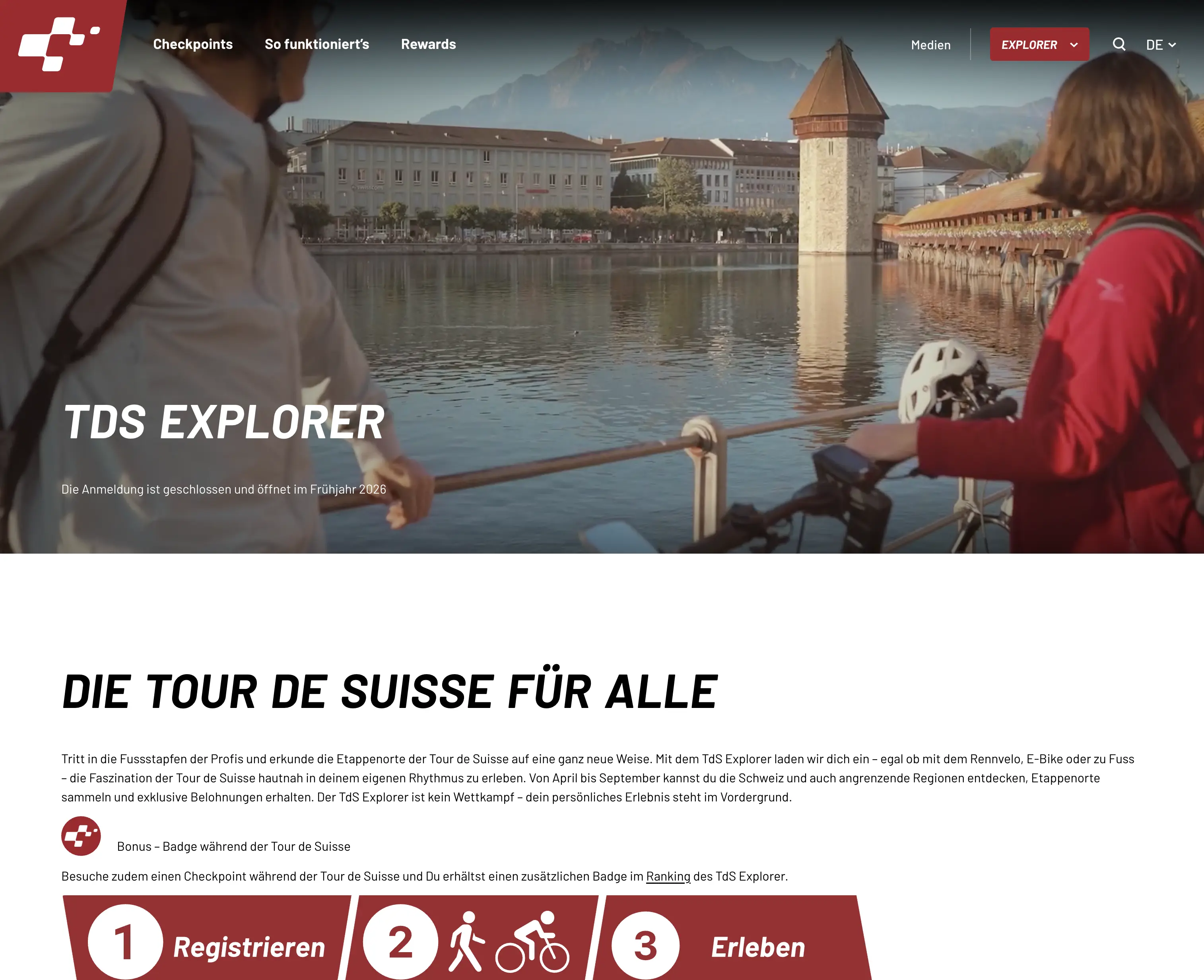
Tour de Suisse Explorer
The TdS Explorer is an open participation challenge: anyone – cyclist, ebiker or pedestrian – can visit the host cities and stage locations of the Tour de …
Learn more →
Trophy
Tour de Suisse Explorer
The TdS Explorer is an open participation challenge: anyone – cyclist, ebiker or pedestrian – can visit the host cities and stage locations of the Tour de …
Learn more →
 Trophy
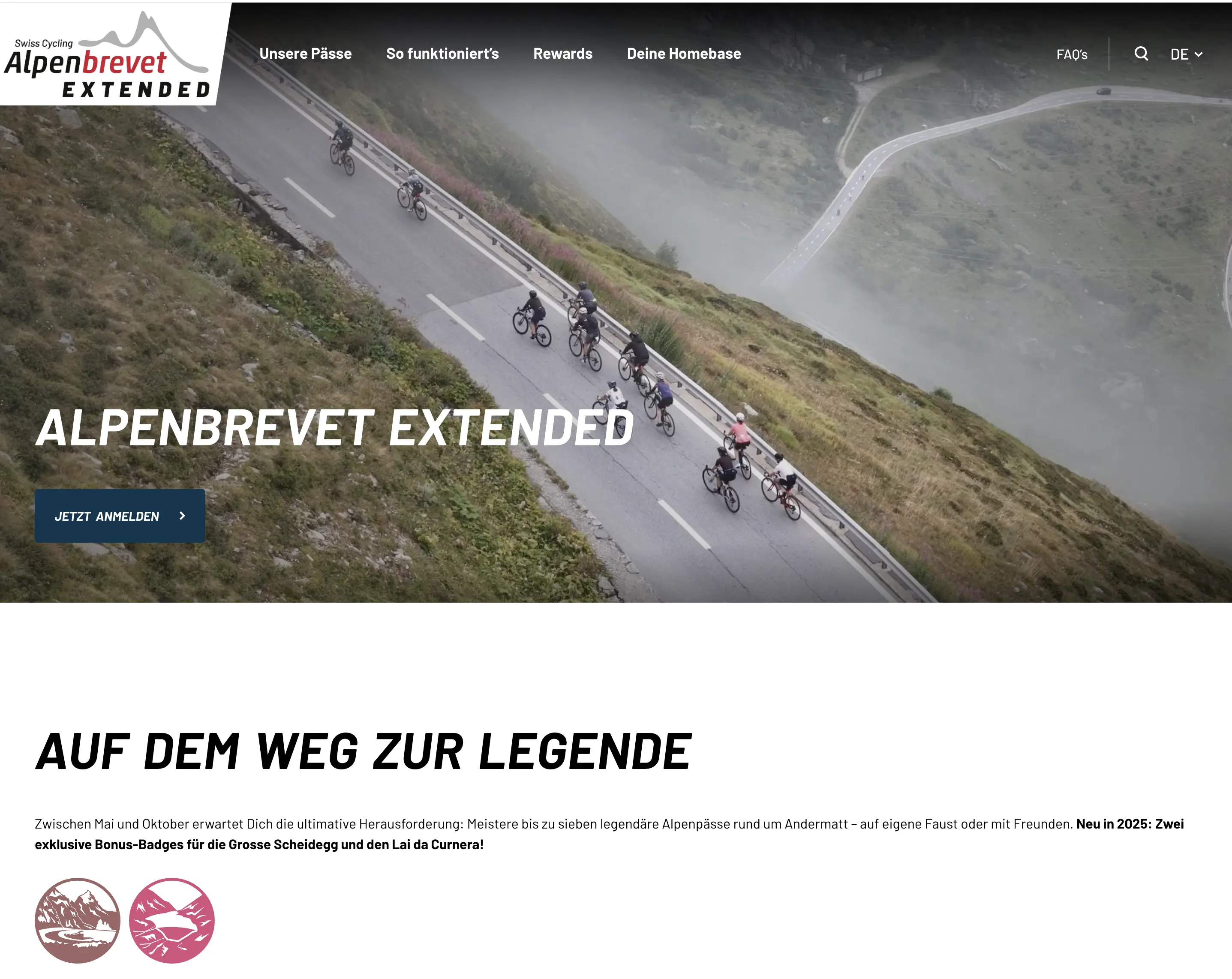
Alpenbrevet Extended
The legendary Alpenbrevet can be ridden all season long – as the "Extended", with 2,000 participants a year, it delivers lasting value for the Andermatt …
Learn more →
Trophy
Alpenbrevet Extended
The legendary Alpenbrevet can be ridden all season long – as the "Extended", with 2,000 participants a year, it delivers lasting value for the Andermatt …
Learn more →
Process
From first conversation to launch
Four steps. Most of the work sits with us.
-
1
A short briefing
You send us what there is: sites, routes, target group, time frame. Twenty minutes are enough to start.
-
2
Concept and quote
We propose format, checkpoints, levels and communication, with a quote that lists every position separately.
-
3
Setup
Set the zones, apply your design, configure sign-up and the email journey, test. The work sits with us.
-
4
Season and evaluation
You communicate, we operate and support. At the end of the season comes the evaluation the next edition is built on.
Questions
What we get asked most often
What about data protection?
The activity data belongs to the participants. What you as the responsible body may evaluate, we define in advance and fix in the agreement. For reports, aggregated, anonymised evaluations are usually sufficient.
We have a procurement procedure. Does that work?
Yes. We deliver the technical specification, the service description and a cost breakdown in the form you need for the tender.
What happens to our existing paper pass?
It can keep running in parallel. Many responsible bodies start with both and see after one season how usage distributes. The pressure to switch is low.
Who operates it long-term?
We do. Operation, participant support and further development sit with us. In multi-year agreements the price per season is stated and plannable.
Investment
What it costs
For multi-year agreements we state the costs per season so they can be budgeted cleanly. Larger networks with more than 25 checkpoints/routes we quote individually.
- PilotCHF 5'000 per season
- SaisonCHF 9'200 per season
- Programmfrom CHF 13'500 per season
- Three-year agreementprices 20 percent lower
Next step
We’ll send you the documents
A concept example for your area, references and a cost breakdown in budget-ready form. No meeting, no obligation.
LaceUp AG
go@laceup.ch
Other areas
Who else we work for
Destinations and mountain railways
Guests come back several times a season instead of once a year.
Organisers and series
Race day becomes a relationship that lasts months.
Brands and sponsors
Activation under your own brand instead of rented reach.
Companies
Activity programmes with real routes instead of generic step counters.
Charity and fundraising
Charity runs with your story and your contacts.